The Hidden Cost of Slow Lead Follow-Up
A practical look at what happens to your revenue when enquiries sit too long, with real numbers and fixes for trade businesses, insurance brokers and dental clinics across the Sunshine Coast, Brisbane and Sydney.
Do you have a marketing problem, or a follow-up problem?
The ads are running. The website is getting visits. The phone rings, the form gets filled in, the Facebook message comes through. The lead exists.
What happens in the next few minutes, or the next few hours, decides whether that lead becomes a client or becomes someone else's client.
Here is the part that rarely gets sat down and worked out properly.
What happens to an enquiry that comes in at 6pm on a Friday? Or on a Saturday morning, while the team is off the tools and out of the office?
Or late on a Sunday night, when someone finally gets around to looking up a quote after putting it off all week?
If the honest answer is "it waits until Monday," that is not a small gap.
For a lot of service businesses, weekends and after hours are when people actually have time to think about what they need and go looking for it.
If nobody is there to catch that enquiry, it does not wait patiently in a queue. It goes to whoever answers first.
Think of a relay race. The runner never slows down to hand off the baton. The handoff happens at full speed, right in stride. A new lead is the baton.
The moment it gets dropped, someone else in the race picks it up and keeps running. That someone else is usually a competitor who was one search result away.
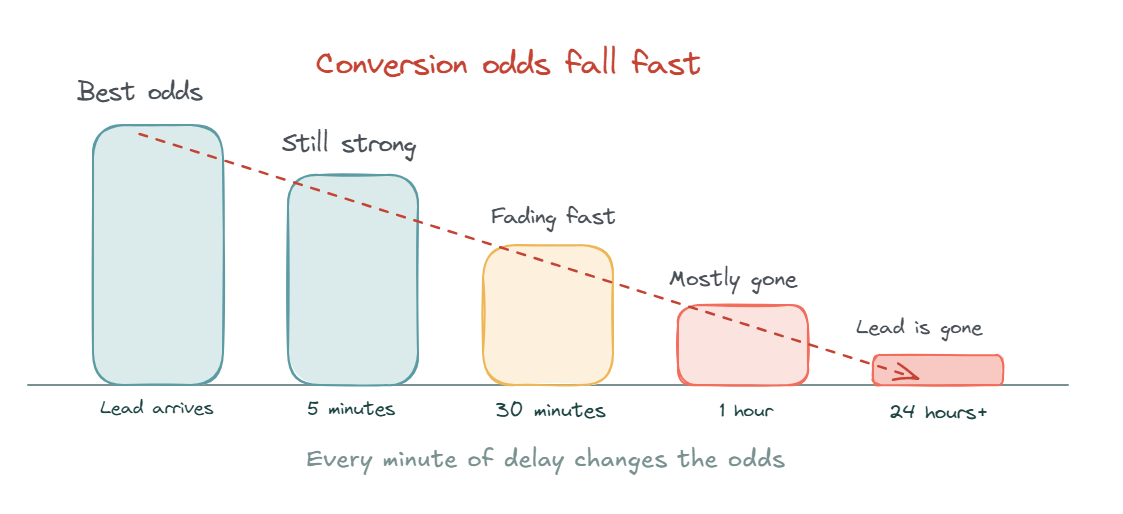
What this actually looks like on a Friday afternoon
It is 4.50pm on a Friday. Your team is packing up for the week.
A new enquiry comes through the website. Someone has been meaning to sort this out for weeks and finally found ten minutes to fill in the form.
They tick "as soon as possible."
Nobody sees it until Monday morning.
By Monday, one of two things has happened. Either they have already booked with the business that called them back Friday night, or the moment has passed.
They are back to being busy, distracted, no longer in the headspace where they were ready to say yes.
Now picture the same enquiry on a Sunday night. Or during school pick-up, when your front desk is flat out and the phone rings through to voicemail. Or over a long weekend, when three days go by before anyone even sees the message.
None of this shows up on a spreadsheet as "lost revenue." It just quietly happens, week after week, and the business never sees the leads that got away, only the ones that stuck around long enough to be counted.
What a slow follow-up actually costs you
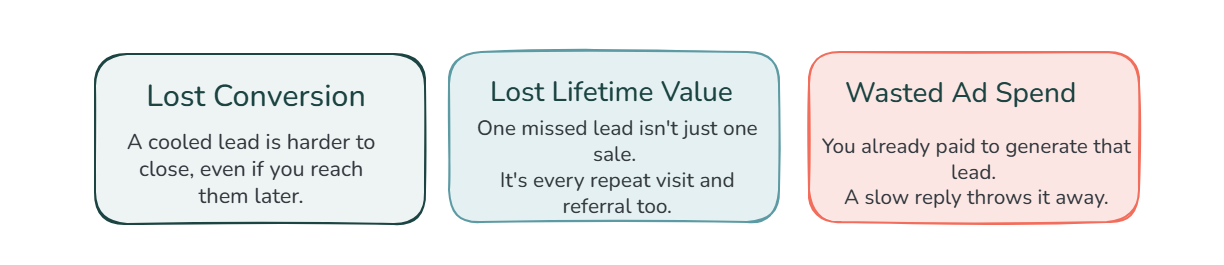
It is not just the one job or the one client. It is the pattern, and it shows up in three places at once.
Conversion. A slow reply does not just risk losing the sale, it makes the sale harder to win even when you do get through. The person has cooled off, moved on to a competitor, or lost the nerve that got them to enquire in the first place.
Catching them straight away, while they are still in the moment, is what turns an enquiry into a booking.
Lifetime value. The client you win today is rarely worth just the one job or one appointment. Repeat visits, referrals, add-on services, renewals, all of that only exists if the relationship starts in the first place.
Every lead lost to slow follow-up is not just one missed sale, it is the years of value that client could have brought with them.
Cost to acquire. You already paid for that enquiry, through ads, SEO, referrals or reputation built over years.
When it goes cold from a slow reply, that spend is gone and you are back to paying for a fresh lead to try again. Businesses that respond fast get more out of every dollar they spend generating leads, because fewer of those leads go to waste.
There is a fourth cost too, and it is harder to see on a spreadsheet. Chasing cold leads is exhausting.
Following up two days late means apologising before you have even started the conversation. Teams end up spending their time managing the fallout of slow response, instead of spending it on the clients who are ready to say yes right now.
“You do not need more leads. You need to stop losing the ones you already have.”
The fix is not more hours, it is a system
This is where automation earns its place, not as a gimmick, but as the part of the business that never gets tired, never gets busy with something else, and never forgets to reply.
An automated first response, a text-back after a missed call, an instant acknowledgment on a DM, all of it buys time. It does not replace the conversation. It protects the lead until a real person can have that conversation properly.
This is exactly what we build inside Growth Systems Implementation using Magnify Hub: instant response across every channel, a simple follow-up sequence for the first 48 hours, and clear rules for when a person needs to step in.
Build a follow-up system that actually works
Set an instant response rule for every channel: calls, forms, SMS and DMs
Turn on automated text-back for every missed call, including weekends and after hours
Build a simple three-touch follow-up sequence for the first 48 hours
Set clear handoff rules for when automation stops and a person takes over
Track every lead in one place, not scattered across inboxes and phones
Review response times every month, not once a year
What this looks like in three different businesses
Speed to lead is not a Sunshine Coast issue, a Brisbane issue or a Sydney issue. It is a competition issue. Anywhere a customer has more than one option to choose from, the business that responds first usually wins the job, not the cheapest one or the most experienced one.
TRADE BUSINESS, SUNSHINE COAST
A homeowner requests a quote at 8pm through Google
No one replies until the next afternoon. By then, three other quotes have already come in, and the homeowner has booked whoever called back first.
The fix: an automated text-back within seconds confirming the enquiry, so the tradie can call properly first thing, ahead of the competition.
INSURANCE BROKER, BRISBANE
A prospect asks for a quote comparison during renewal season
Staff are flat out and the request sits for two days. By the time someone picks it up, the prospect has already signed with a competitor.
The fix: an instant acknowledgment with a booking link for a call back, so busy staff are not the ones racing the clock on every single enquiry.
DENTAL CLINIC, SYDNEY
A new patient sends an Instagram DM about a specific treatment
Reception is with patients in the chair and does not see the message until the end of the day. The patient has already messaged another clinic.
The fix: an automated DM reply with a booking link and answers to common questions, holding their interest until the front desk can follow up personally.
Related reading: We have written more on why response speed matters more than ad spend, and how this plays out for Sunshine Coast businesses specifically.
Common questions

Take the Freedom Checker Quiz
You're doing well. But you know there's another level you haven't reached yet. This 27-question quiz shows you exactly where your time is going — and what to fix first to get some of it back.
Show Me Where My Time Is Going →