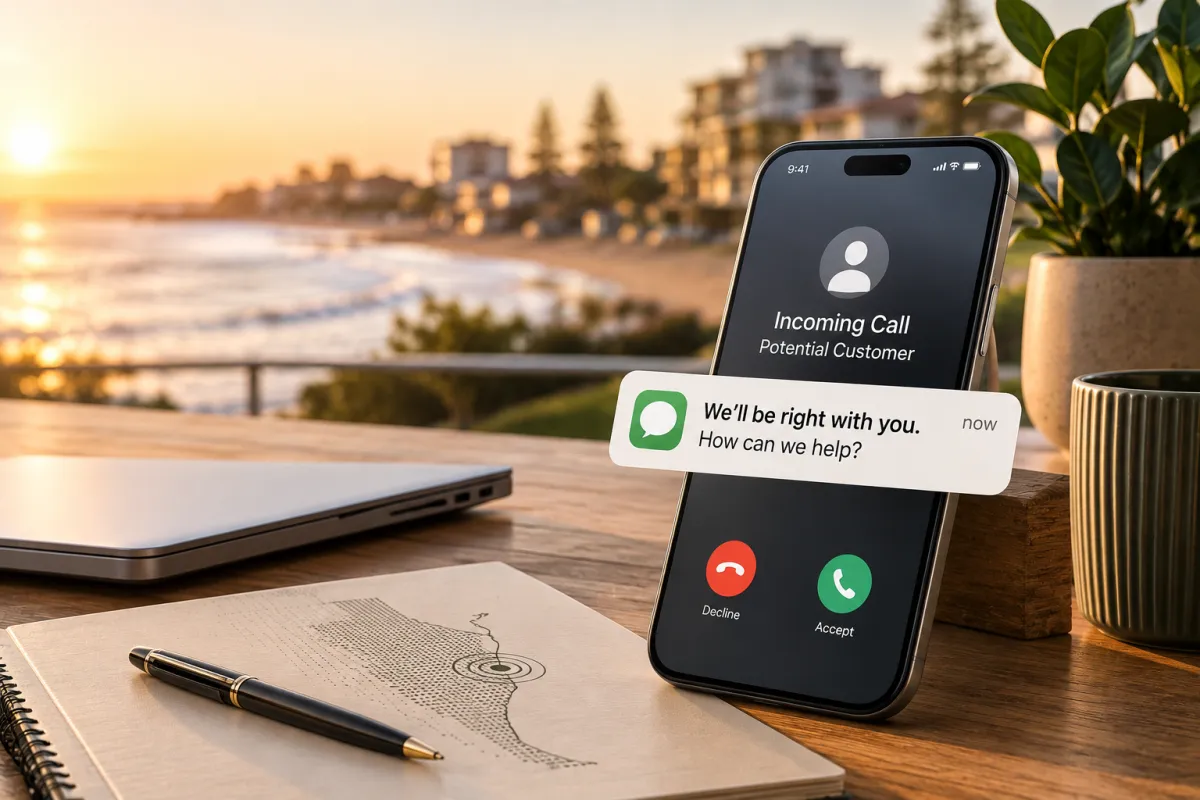
Whoever Calls Back First Wins
If you run a business in Maroochydore, Noosa or Buderim, your biggest competitor is not the one with the bigger team or budget. It's the one that replies faster.
The Sunshine Coast is not a big city. It is a string of tight local markets, Maroochydore, Noosa, Buderim, Caloundra, Mooloolaba, where word travels fast and the pool of customers searching for your service on any given day is small.
That works against you the moment someone else answers the phone before you do. Buyer expectations have shifted too, recent Salesforce research puts the number of consumers expecting a real time response at 64 percent, up from 58 percent just a couple of years ago.
Here is what actually happens when a lead goes cold. Someone searches "plumber near me" or "day spa Noosa" on their phone, calls two or three local businesses in the space of ten minutes, and books with whoever picks up or texts back first. It is rarely about who has the best reviews or the sharpest price. It is about who showed up first in that moment.
MAROOCHYDORE EXAMPLE
A Maroochydore electrician gets a call while he is up a ladder mid job. He cannot answer, the call goes to voicemail, and the caller hangs up without leaving a message. Three suburbs away, a second electrician has missed call text back running. The same caller gets a text within thirty seconds asking what they need help with. Same missed call, two very different outcomes.
Why This Hits Harder on the Sunshine Coast Than in a Big City
In a capital city, a slow response might cost you a customer to a competitor across town you will never think about again. On the Sunshine Coast, that customer often becomes a Google review, a mention in a local Facebook group, or a recommendation at their kid's soccer game.
Small markets punish slow follow up twice, once through the lost sale, and again through what that person tells their neighbours.
NOOSA EXAMPLE
A Noosa beauty clinic runs seasonal ads through summer and gets a steady stream of enquiries through Instagram and their website form. The forms sit in an inbox that gets checked twice a day. By the time someone replies, half the enquiries have already booked in with a clinic that answered on the day. The ad spend was fine. The follow up speed was the actual problem.
The Real Cost of "We'll Call Them Back Later"
Most owners are not ignoring leads on purpose. They are on the tools, in client meetings, or simply flat out running the business. The problem is not effort, it is that follow up depends entirely on someone finding a spare five minutes, and on a busy day that spare five minutes never comes.
BUDERIM EXAMPLE
A Buderim accounting practice gets most new enquiries through referrals and a contact form. The founder wants to personally respond to every enquiry because it feels like good service. In reality, some enquiries wait three or four days for a reply because that is how long it takes to find the time. By then, most people have already engaged someone else, often a firm with a less impressive reputation but a faster reply.
A missed call is not just a missed call. In most service businesses, it is $500 to $5,000 walking out the door and into a competitor's.
What Actually Fixes This
You do not fix a follow up problem by trying harder. You fix it by taking the response out of your own hands and putting it on autopilot, so a lead gets a reply the moment they reach out, whether that is nine in the morning or nine at night on a Sunday. Here is what that looks like in practice.
1. Missed Call Text Back
The moment you miss a call, the caller gets an automatic text asking what they need and offering a time to chat. It works whether you are on a job, in a consult, or asleep. This alone recovers a large share of leads that would otherwise vanish into voicemail.
2. SMS Marketing and Follow Up Sequences
Beyond the first reply, automated SMS sequences nudge quotes and enquiries that have gone quiet, remind people about upcoming appointments, and re-engage anyone who enquired but did not book. Text messages get opened far faster than email, which matters when someone is comparing three local businesses in the same afternoon.
3. Voice AI
For calls you cannot pick up, Voice AI answers, holds a natural conversation, handles common questions, and can book straight into your calendar. It is not there to replace talking to your customers, it is there to make sure nobody hits a dead end when the phone rings and everyone is busy.
4. Automated Appointment Setters
Once someone shows interest, an automated setter follows up, answers basic questions, and locks in a booking without anyone on your team having to chase them manually. For trades, clinics and professional services across the Coast, this is often the single biggest time saver in the whole lead process.
Signs Your Sunshine Coast Business Is Losing Leads to Slow Follow Up
Missed calls go to voicemail and nothing happens next
Website and Facebook enquiries sit unread for hours or days
Quotes get sent but nobody follows up if the customer goes quiet
After hours and weekend enquiries wait until Monday
You are relying on memory, not a system, to chase leads
None of this is solved by working harder or answering your phone more often. It is solved by building a system that responds on your behalf, every time, whether you are on the tools in Buderim, mid consult in Noosa, or driving between jobs in Maroochydore.
Keep Reading
Why Your Leads Aren't Converting (And It's Not Your Marketing), the full breakdown of why follow up speed matters more than ad spend
Why Your Leads Are Going Cold Before You've Even Called Them Back, a deeper look at speed to lead systems, with cost comparisons against hiring staff
Five Things I Would Fix in Any Service Business Before Spending on More Marketing, the anchor piece pulling the whole Found, Won, Kept framework together
Frequently Asked Questions
References
1. Artemis GTM (2026). Speed to Lead Benchmark Study. Analysis of 253,817 inbound leads across 1,247 B2B companies. Found a median first-response time of 42 hours, and confirmed that leads contacted within 5 minutes qualify at 21 times the rate of leads contacted after 30 minutes, a result consistent with the original 2007 MIT Sloan/InsideSales.com study by Dr. James Oldroyd that first identified this benchmark.
2. Optifai (2026). Pipeline Study, 939 B2B companies. Found that only 23 percent of companies respond to a new lead within 5 minutes, despite the well documented conversion advantage of doing so.
3. Salesforce, State of Sales Report. Found that 64 percent of consumers now expect a real time response when they contact a business, up from 58 percent in the prior edition.
4. Missed call cost estimates ($500 to $5,000+ per lead) are drawn from 2026 industry cost-of-a-missed-call research across home services, trades, health and professional service sectors, where per-lead value scales with average job or client value. Compiled from AgentZap and Dialora missed call cost analyses (2026).
Take the Freedom Checker Quiz
You're doing well. But you know there's another level you haven't reached yet. This 27-question quiz shows you exactly where your time is going — and what to fix first to get some of it back.
Show Me Where My Time Is Going →