
9 Reasons Your Business Growth Has Stalled (And What Each One Is Really Costing You)
Revenue used to climb on its own. Now it has flattened out, and you have tried everything you can think of. Here is the truth: it is almost never one big problem. It is nine small, fixable leaks quietly working against you at the same time.
At a Glance: The Numbers
10.5 hours a week: the average time an Australian small business owner spends on admin (Xero Small Business Insights, 2024).
Around $79,000 a year: the estimated average admin cost carried by Australian SMBs (Sage SMB survey).
22 to 62%: the range industry research suggests for inbound calls to Australian service businesses that go unanswered.
You didn't build this business to spend your Sundays wondering why growth has gone quiet.
Most business owners blame the market, the pricing, or "just needing more leads." Sometimes that's true.
Far more often, the real story is a handful of small operational gaps that have been there for months, quietly costing you time, money and headspace.
The good news is that every one of these is fixable once you can actually see it.
Below are the nine most common reasons growth stalls in established, founder-led service businesses, what each one is likely costing you in real Australian dollars, and what to do about it, whether that's a fix you make yourself this week or a job you hand to someone else.
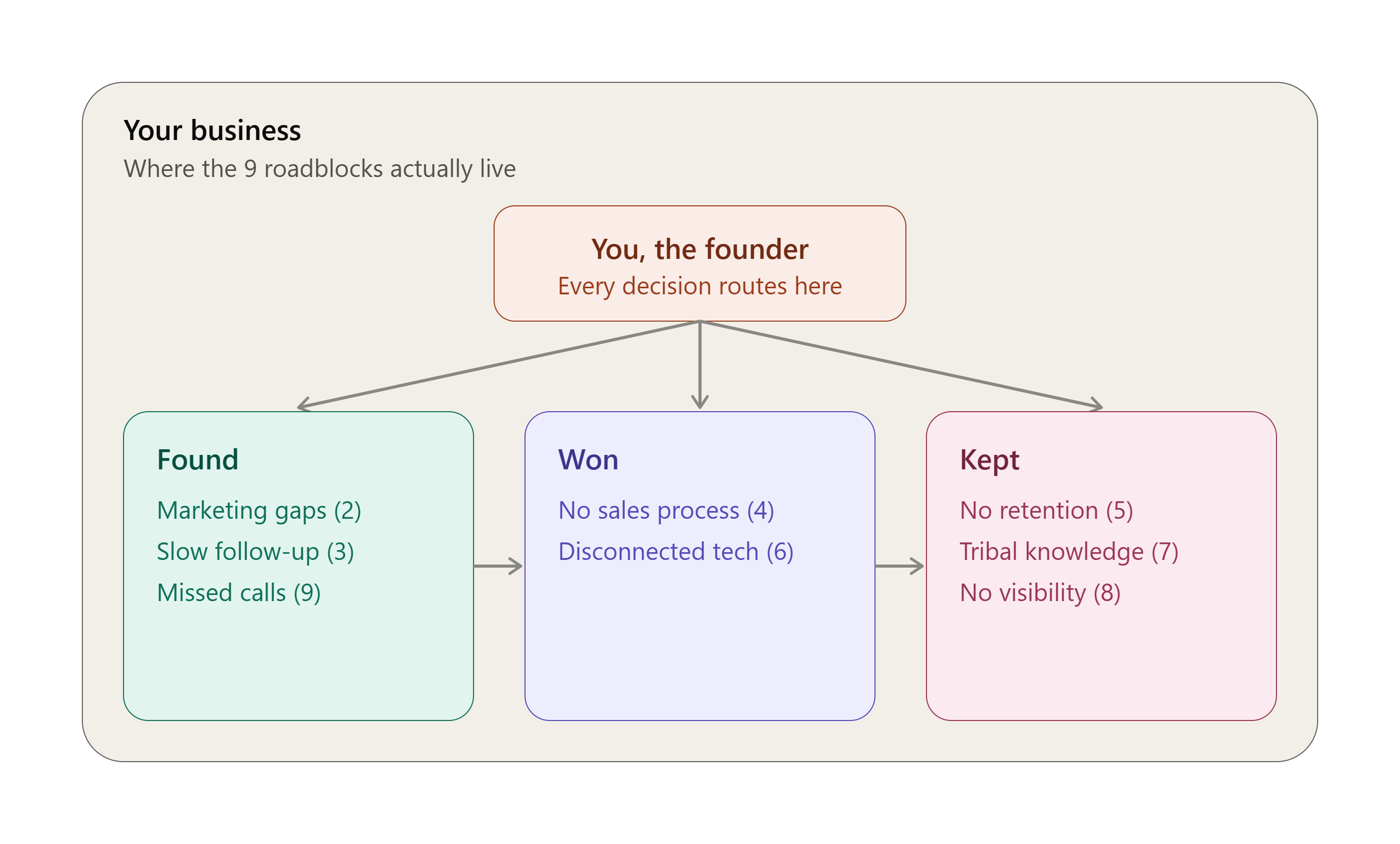
The 9 Growth Roadblocks at a Glance
Use this as your quick diagnostic. Skim it, be honest with yourself, and then read the sections that sting the most.
1. You're Still the Bottleneck for Every Decision
The Problem
Every price exception, every hire, every client escalation, every social media caption, it all still lands on your desk. Your team is capable. They just aren't allowed to actually decide anything without you.
Why It's Getting Worse
Take a full week off and watch what happens. If things grind to a halt or pile up waiting for you to get back, you've found your bottleneck, and it's you. The business can only grow as fast as you personally can move.
WHAT THIS IS COSTING YOU
Founders in this pattern are commonly reported to work 45 to 50+ hour weeks, with a large share on decisions a trained team member could make. Valuing your time at modest $100 an hour and freeing up 10 hours a week is roughly $52,000 a year of your time back.
The Fix
Delegate outcomes, not tasks. Write down what "good" looks like for the five decisions your team asks you about most, then hand over the authority to match.
AUDIT YOURSELF
List every decision that came to you this week. How many actually needed your judgement, and how many just needed someone with permission to say yes?
2. Marketing Is Inconsistent, So Leads Come and Go
The Problem
Some months are flat out. Other months you're wondering where everyone went. This isn't a sign the market has dried up, it's usually a sign your marketing runs on whatever time you have left over, rather than on a schedule.
Why It's Getting Worse
A campaign is a burst of activity. A system runs whether you're busy, tired, or on leave. Without the system, every quiet patch in your marketing shows up as a quiet patch in your pipeline six to eight weeks later.
WHAT THIS IS COSTING YOU
For a business turning over $500,000 to $1 million a year, even a 10% swing in consistent lead flow is commonly worth $50,000 to $100,000 in revenue that either shows up reliably or doesn't.
AUTOMATION RECOMMENDATION
A content and campaign calendar built into Magnify Hub, with posting, nurture emails and ad refreshes running on a schedule rather than your memory.
AUDIT YOURSELF
Look at your last six months of leads by week. Is there a pattern of feast and famine, and does it line up with quiet patches in your own marketing activity?
3. Leads Get Found, Then Fall Through the Cracks
The Problem
A lead comes in. It sits in an inbox, a spreadsheet, or someone's memory. By the time anyone replies, the moment has passed and the enquiry has gone cold, or gone to whoever answered first.
Why It's Getting Worse
Speed to lead matters more than most business owners realise. The business that replies within minutes wins the job far more often than the one with the better price, simply because they answered first.
WHAT THIS IS COSTING YOU
If your average job or client value is $1,000 and you're losing even one enquiry a week to slow follow-up, that's roughly $52,000 a year walking to a competitor who replied faster.
AUTOMATION RECOMMENDATION
Automated speed-to-lead in Magnify Hub, an instant SMS or email the moment a form is submitted, followed by a structured nurture sequence, so no enquiry sits untouched overnight.
AUDIT YOURSELF
Pick your last 20 enquiries. How long, on average, before someone actually replied?
4. There's No Real Structure to How You Win the Client
The Problem
Ask three people on your team to walk you through how a lead becomes a paying client and you'll likely get three different answers. Whoever picks up the enquiry decides how it gets handled, quoted, and closed.
Why It's Getting Worse
Without a documented pipeline, your best salesperson's habits live only in their head. When they're busy, sick, or leave, that close rate leaves with them.
WHAT THIS IS COSTING YOU
Even a 10% point gap between your best closer and everyone else, applied across 100 quotes a year at a $1,500 average value, is $15,000 in deals that were winnable but weren't won.
The Fix
Map the exact steps a lead currently goes through, from first contact to signed job, not how it's supposed to go, how it actually happens.
Standardise the parts that should be consistent for every client.
AUDIT YOURSELF
Could a new team member run your sales process from a document alone, without shadowing you first?
5. Clients Get Won, But Never Really Kept
The Problem
The job finishes, the invoice is paid, and then, nothing. No follow-up, no review request, no reason for that client to think of you again or send someone your way.
Why It's Getting Worse
Winning a new client is almost always more expensive than keeping one. Without a Kept stage, you're stuck permanently chasing new leads to replace clients who would have happily stayed or referred, if anyone had asked.
WHAT THIS IS COSTING YOU
A modest referral and repeat-business rate of even 15% of your client base, at an average value of $1,000, is $15,000 in revenue you're leaving on the table for every 100 past clients you've done nothing to reactivate.
AUTOMATION RECOMMENDATION
An automated review and referral sequence in Magnify Hub, triggered the moment a job is marked complete, plus a simple reactivation campaign to past clients who haven't heard from you in six months or more.
AUDIT YOURSELF
When did you last hear from a client you haven't worked with in the past year? Did you reach out, or did they?
6. Your Tools Don't Talk to Each Other
The Problem
Your CRM doesn't match your accounting software. Your booking system is separate to your invoicing. Someone on your team is retyping the same client details into three different places, several times a week.
Why It's Getting Worse
Every manual re-entry is a chance for a typo, a missed step, or a client detail that goes stale in one system while it's updated in another.
WHAT THIS IS COSTING YOU
If a team member spends even 5 hours a week manually moving data between disconnected systems, at a fully loaded cost of $40 an hour, that's over $10,000 a year spent on work that shouldn't exist.
AUTOMATION RECOMMENDATION
A tech stack audit to find the top three places your team re-enters data by hand, then connecting those systems through Magnify Hub so information flows through once and updates everywhere.
AUDIT YOURSELF
List every tool your business uses. Circle any pair that doesn't automatically share information.
7. The Business Runs on What's in Your Head
The Problem
How to handle a difficult client. How pricing actually works for edge cases. Which supplier to use when the usual one is booked out. None of it is written down. All of it lives with you, or with one or two long-term team members.
Why It's Getting Worse
When knowledge only lives in people's heads, the same questions get asked over and over, decisions get remade from scratch each time, and the business is one resignation or sick day away from a genuine problem.
WHAT THIS IS COSTING YOU
Replacing an experienced employee in Australia is commonly estimated at 50 to 150% of their annual salary once recruitment, onboarding and lost productivity are counted. For a $70,000 role, that's $35,000 to $105,000.
The Fix
Start with the three processes that would hurt the most if the person doing them disappeared tomorrow. Document those first, in plain steps anyone could follow.
AUDIT YOURSELF
If your most experienced team member took a month of leave with no notice, what would actually break?
8. You Don't Actually Know Your Numbers
The Problem
Revenue looks fine on paper. But if someone asked which service or offer was genuinely the most profitable last quarter, could you answer with real numbers, not a gut feeling?
Why It's Getting Worse
Without clean, current financial reporting, you're making growth decisions blind. You might be pouring effort into your least profitable offer simply because it feels busy.
WHAT THIS IS COSTING YOU
Australian small business owners are reported to spend around 10.5 hours a week on admin, including financial admin, much of it after hours. At $75 to $100 an hour of opportunity cost, that's $40,000 to $52,000 a year of your time going into paperwork instead of the numbers that would actually change a decision.
Sources: Xero Small Business Insights 2024, Sage SMB admin survey. Ranges are industry estimates, verify against your own reporting.
The Fix
Set a simple monthly close process, even a basic one, so you always know revenue and margin by offer.
AUDIT YOURSELF
Could you name your three most profitable clients or offers from last quarter right now, with numbers?
9. Missed Calls and Slow Replies Are Bleeding Revenue
The Problem
You're with a client, on the tools, or in a meeting, and the phone rings out. Industry research puts the miss rate for Australian service businesses at anywhere from 22% to over 60%, particularly during business hours and after 5pm.
Why It's Getting Worse
Most callers who reach voicemail don't leave a message. They call the next business on the list instead. A missed call is frequently a missed job that's gone to someone else within minutes.
WHAT THIS IS COSTING YOU
Using a common industry formula (average job value x weekly call volume x miss rate x conversion rate), a business with a $450 average job value missing just one legitimate enquiry a day can lose over $100,000 a year. A more conservative estimate of one missed call a week at the same job value runs to roughly $10,000 to $13,000 a year.
Sources: industry research and vendor studies on missed-call rates for Australian small businesses (ranges vary widely, 22 to 62%). Treat as directional, run your own numbers using actual job value and call volume.
AUTOMATION RECOMMENDATION
Voice AI or SMS AI through Magnify Hub answering every call that would otherwise ring out, capturing enquiry details and booking or handing off urgent calls, so a missed call stops meaning a missed job.
AUDIT YOURSELF
Check your phone's missed call log for the last two weeks. How many of those calls got a callback within the hour?
"Stalled growth is almost never one big, dramatic problem. It's nine small leaks, quietly working against each other, until the whole business feels heavier than it should."
Mazzy Torre, Amigo Marketing
Your Full Self-Audit Checklist
Before you decide what to fix first, go through this list honestly. Tick what's already true for your business.
Your team can make day-to-day decisions without waiting on you
Marketing activity runs on a schedule, not on however much time you have left
Every new enquiry gets a reply within the hour, day or night
Your sales process is written down, step by step, and used consistently
Past clients hear from you at least once every six months
Your core systems share client information automatically
Your top five processes are documented well enough that someone new could follow them
You can name your most profitable offer from last quarter, with real numbers
Missed calls are captured and followed up automatically, not left to voicemail
If you ticked six or more, your foundations are solid and it's about refining what's already working. If you ticked three to five, you've got real leaks worth plugging before you spend another dollar on lead generation. If you ticked two or fewer, growth isn't a marketing problem right now, it's an infrastructure one.
Do It Yourself, or Bring in Help? When to Hire
Not every one of these nine needs a consultant. Some are a weekend of documentation. Others genuinely need a second set of hands, or a system built properly the first time.
DIY Territory: Fix It Yourself This Week
You have the time, and the fix is mostly about writing something down or changing a habit. Documenting your top three processes, setting a review request template, or blocking out a weekly marketing hour all fall here.
Get a Second Opinion: Free Diagnostic First
You're not sure which of the nine is actually costing you the most, or where to start. Take the Freedom Checker. It's a free, three-minute self-assessment that shows you exactly where your business is entangled and what it's likely costing you.
Bring in Help: Time to Hire It Out
You don't have the time, the internal skill, or the objectivity to fix this properly yourself, and every month it stays broken is costing real money. This is when a paid Business Growth Review and Growth Systems Implementation earns its price back quickly.
A rough guide worth using honestly: if a fix would take you more than a few hours a week for more than a month, or if it touches systems and automation you've never built before, that's usually the point where doing it yourself starts costing more in delay and rework than it would to bring someone in who's built this exact thing before.
Common Questions

Take the Freedom Checker Quiz
You're doing well. But you know there's another level you haven't reached yet. This 27-question quiz shows you exactly where your time is going — and what to fix first to get some of it back.
Show Me Where My Time Is Going →